- SODP Weekly Bulletin
- Posts
- The Weekly Bulletin | August 5, 2025
The Weekly Bulletin | August 5, 2025
Catch up on your members' content, check out the community buzz, and browse through job opportunities

Vahe Arabian
August 05, 2025

Hi SODP community,
Let’s recap on what’s been happening, the new content, industry updates, tips, and more.
A Publisher’s Engagement Playbook!
🚀 We’ve launched the first industry research report in partnership with Glide Publishing Platform!
Join global publishing leaders, product owners, data strategists, and tech innovators to benchmark how your team personalizes, engages, and grows using first-party data.
🔍️ What’s in it for you?
Benchmark CDP Engagement, Adoption & Performance
Discover Emerging Personalization Trends
Access Actionable Best Practices
Learn From Real-World Challenges & Wins
Whether you're using behavioural signals, AI-powered tools, or topic-based tagging, your insights matter. Help shape a report that reflects what’s really driving results across the industry.
👉️ Take the survey now! We need 300 respondents, and the survey closes in a week. Be the first to receive exclusive insights.

TIP OF THE WEEK
Page views won’t future-proof your publishing business; branded search will.
AI-generated content has opened new doors for publishers. However, many are still relying on legacy metrics, such as page views, sessions, and impressions, to measure success. These numbers can indicate reach, but they don’t tell the full story, especially when it comes to long-term brand value.
If you're not tracking branded search, you're missing the signal that really matters.
Branded search reflects earned relevance. It shows that your audience isn’t just discovering your content; they’re seeking you out deliberately. That’s the kind of loyalty that fuels subscriptions, partnerships, and lasting growth.
Page views can spike for the wrong reasons: clickbait headlines, trending topics, or even AI-generated content that’s overly generic. But branded queries come from people who already know you. They signal authority and familiarity. They’re also a strong indicator that your content, AI-assisted or not, is resonating at a deeper level.
If your AI strategy focuses solely on traffic volume, it risks becoming just noise. But if it supports your brand’s credibility, tone, and voice, it becomes a tool for amplification.
Don’t let your team get lost in shallow performance data. Instead, create systems that connect AI content to brand trust:
Monitor branded search volume in Google Search Console. Track month-over-month changes and look for patterns around key content or campaigns.
Segment return users engaging with AI-generated content. Use analytics platforms like GA4 or Chartbeat to see whether AI outputs are encouraging deeper engagement.
Track direct visits, scroll depth, and engaged time. These are stronger indicators of trust than bounce rate or session count.
3 tactical shifts to amplify branded search
Use branded keywords naturally. Mention your brand 3–5 times per 1,000 words where it fits. Include bylines that reinforce institutional expertise (e.g., “By [Name], State of Digital Publishing”).
Transform generic content into brand-owned frameworks: Instead of “5 SEO Tips,” write “SODP’s 5-Point Local SEO Audit Framework.” Brand your approaches and repeat them across channels.
Prioritise transparency and quality in AI workflows: Clearly label AI-assisted content. Include editor’s notes or expert reviews to signal trust. Don’t hide the human touch, highlight it.
Here are the takeaways
Branded search is a forward-looking metric. It tells you whether you’re building something worth remembering.
Page views show trends. Branded queries show trust.
AI should support your editorial vision, not dilute it.
Winning in publishing today requires more than content volume; it requires content value.
SODP POSTS
Mastering Content Engagement: Key Metrics and Strategies
Publisher success boils down to attracting, keeping and growing audience numbers. And that depends on producing killer content.
The publishing world is incredibly competitive, with audiences demanding to be wowed with each piece of new content. Successful content must be visible, memorable and shareable to stand a chance in an increasingly crowded content arena. Every new piece needs a catchy headline, stellar SEO, eye-grabbing visuals and compelling storytelling.
This makes content engagement a critical metric to understand, given that it defines how effective publishers are connecting with their audiences. Let’s take a closer look at the vital elements of content engagement, dissecting what it means, the best ways to measure it and techniques to enhance it.
What Is Content Engagement?
Content engagement measures a piece of content’s effectiveness at getting the audience to interact, share and take a relevant action. It extends beyond pageviews and likes to encapsulate a range of behaviors, including clicking on links, commenting and sharing posts. The ultimate goal is to create engaging content that sparks these various forms of interaction.
These interactions serve as valuable touchpoints, providing real-time insights into audience preferences and behaviors. More than just statistics, they offer a window into how audiences experience content, allowing publishers to refine and improve their strategies accordingly.
JOB BOARD
➡️DMG media is looking for an editorial insights executive who will be responsible for providing data-driven insights and recommendations to the audience team, journalists, and editors, and also monitor, analyse and report organic traffic data and identify opportunities to grow the audience. (London). SEE MORE
➡️ Nine is looking for a multimedia producer who will be creating, editing, and distributing killer video for entertainment, perfectly tailored for every audience, and also innovate new media storytelling to bring content to new audiences . (Australia). SEE MORE
COMMUNITY BUZZ
Industry News
➡️ We’re in the middle of a video boom. Australians are consuming more content than ever, on more screens, in more formats, across more platforms. For marketers, it should be a golden opportunity. But instead of clarity and scale, many are grappling with complexity and fragmentation. Today’s screen footprint is increasingly difficult to navigate. Planners and buyers are stitching together campaigns across multiple vendors, demand-side platforms (DSP), creative formats and performance metrics, often just to deliver reach. But here’s the thing: not all reach is created equal. READ MORE
➡️ Cloudflare’s recent post calls out Perplexity for operating undeclared web crawlers, quietly sidestepping robots.txt while using a stock chrome agentname. Cloudflare’s tone hints at alarm, but if you’ve been running a server for any length of time – or spent even five minutes on WebmasterWorld – you already know the score. Undeclared Crawlers? Yawn. This behavior isn’t novel. It’s not rare. It’s not even especially clever. At WebmasterWorld, we’ve tracked rogue bots for decades. What Perplexity is doing is more the norm than the exception. READ MORE
➡️ Google is preparing to scale up ads in AI Mode, by briefing agencies and brands on how the new ad format works and how it differs from traditional search. Driving the news. A new internal document, first reported on by Ad Age, outlines how ads in AI Mode will function. The company says it will target ads based not just on a user’s query, but on the entire context of the AI conversation, marking a departure from traditional keyword-based targeting. The guide includes a section titled “Ads in AI Mode,” detailing how exploratory and complex user queries will influence ad placements. READ MORE
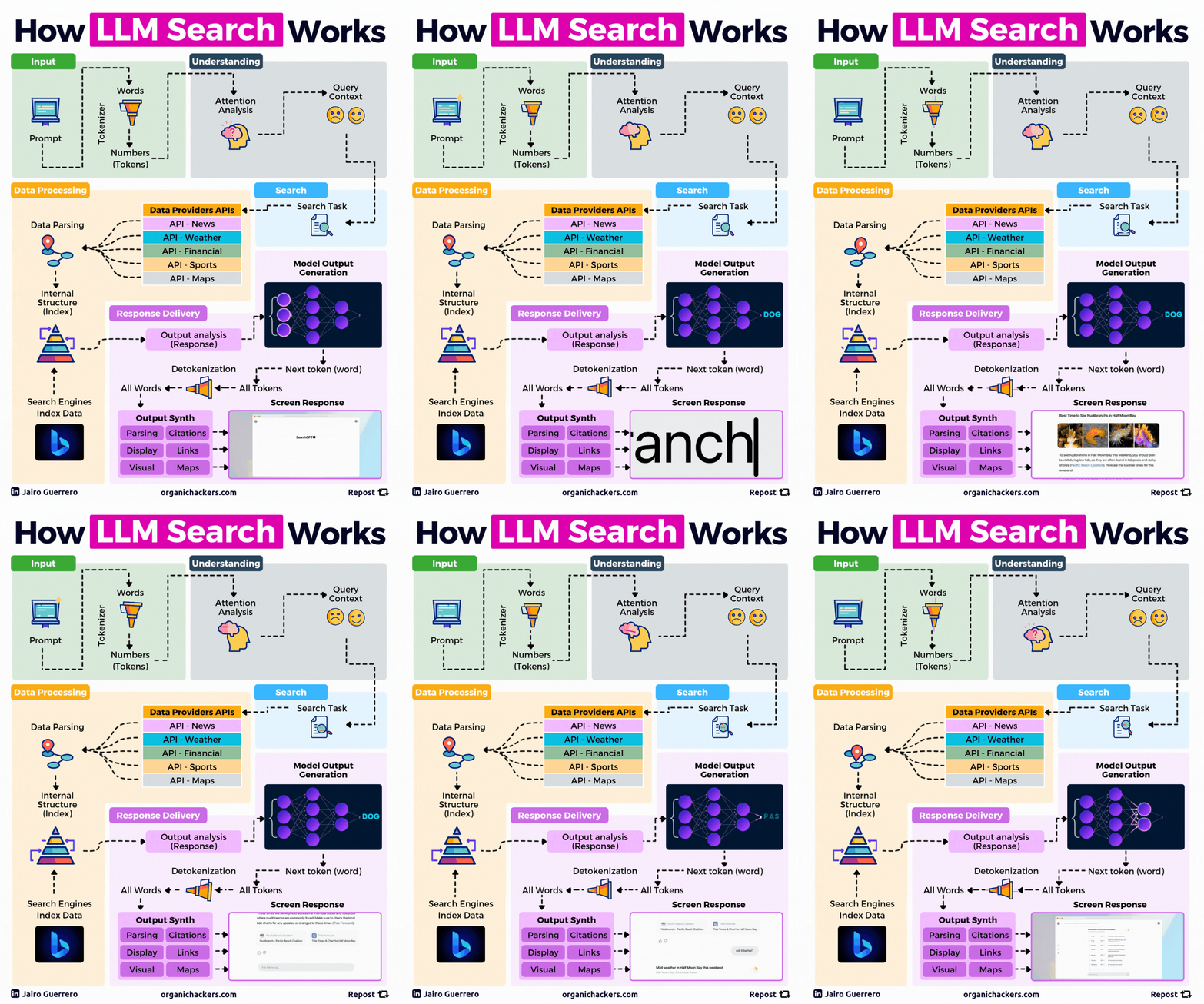
➡️ Jairo Guerrero on LinkedIn:
How Does LLM Search Work?
[many of you have asked me for this post]
"How can I rank in GPT?" "How does GPT process queries?" "What happens after I type my prompt?" "How does GPT gives the right answer?"
The point to be made: LLM search is a marketing channel (a new one)
You better understand it asap
How LLM Search works In 10 simple steps:
Input → You type a question or prompt
Understanding → GPT processes it into tokens
Context → GPT identifies the context and intent
Data Processing → Retrieves info via APIs and search engines
Indexing → Parses and indexes the data for relevance
These are the highlights for the last week.
Until next!
Vahe Arabian and the editorial team at SODP
Social Media Discussions