- SODP Weekly Bulletin
- Posts
- The Weekly Bulletin | March 4, 2026
The Weekly Bulletin | March 4, 2026
Catch up on your members' content, check out the community buzz, and browse through job opportunities

Vahe Arabian
March 04, 2026
Hi SODP community, happy new month.
Let's recap on what's been happening, the new content, industry updates, tips, and more.
.TIP OF THE WEEK.
What Publishers Should Build When AI Eats Everything Else
AI summaries are killing commodity content, but not everything.
The content that’s still winning shares one thing in common: its value can’t be extracted without user action, context, or participation.
Based on what’s actually working right now, here are the alternatives publishers should be paying attention to:
Interactive experiences
Quizzes, assessments, configurators, calculators.
Not because they’re “engaging,” but because the value doesn’t exist until the user interacts. AI can explain. It can’t do the work for you.Systems of record, not explanations
Benchmarks, trackers, live datasets, market maps, and regulatory updates. These aren’t “how things work” pages. They’re where people check reality repeatedly. Freshness + ownership beats optimisation.Decision-support content
Comparison engines, trade-off visualisers, prioritisation frameworks. AI can list options. It can’t resolve your constraints. When the stakes are real, users still click.Video that shows proof, not opinions
Walkthroughs, demos, process recordings. AI can summarise text. It can’t replicate visual evidence, trust, or human presence.Participation-driven content
Communities, discussions, user contributions. The value isn’t the information; it’s the interaction. And it keeps growing after publication.
The shift isn’t: “How do we rank?”
It’s: “What value only exists after someone clicks?”
The brands winning in AI search aren’t producing more content. They’re building experiences, systems, and infrastructure that can’t be summarised away.
.NEWS OF THE WEEK.
➡️ The Verified Source Pack Agents Trust First. Structured data helped machines interpret pages. It reduced ambiguity. It made entities and attributes legible to crawlers that were otherwise guessing. Agents change the job because they do not just interpret pages. They decide, summarize, recommend, and sometimes execute. That means they need more than “this page is about X.” They need “this is the official truth about X, it is current, and you can verify it.” That is the gap most teams have not addressed yet. If you are a technical SEO, you’ve already done the hard part of this job in other forms.
➡️Organic social media isn’t failing – low-value output is. For years, B2B brands have measured social media success in likes, shares, and the ability to ‘hack the algorithm.’ But the truth is becoming increasingly clear: organic social media isn’t failing; low-value output is. The era of quantity over quality, of flashy hacks and recycled templates, is over. Today, success hinges on two things: human connection and radical utility. Much like Google’s early battle with web spam, video-first social platforms are now saturated with unoriginal, low-quality filler content. Endless streams of polished, formulaic posts may look professional, but they have fostered a form of fatigue among users.
➡️ What it looks like when creators build newsrooms. Last week, Johnny Harris — former Vox video journalist whose YouTube channel alone has over 7.5 million subscribers, many of them exactly the young, news-curious audience legacy media is trying to reach — announced Newpress, a platform for “creator-led, community-driven journalism.” What makes it interesting isn’t just the ambition. It’s the structure. Newpress pays its journalists a salary with revenue share. It provides editors, producers, and animators editorial feedback. Harris called it “our answer to a world where a handful of platforms run by the richest man now decide what billions of us see, read, and believe.”
➡️ WordPress Security in 2026 What the Data Says and What You Must Do. Hat tip to Roger Monti for staying dog-on-bone about WordPress security front. We need more like that! I am lucky enough to have several ongoing consulting positions with SEO firms. That has allowed me over the years to look behind the curtains of hundreds of websites running WordPress. The most troubling thing is how many sites are running plugins that haven’t been updated in weeks, months and in some cases – flippin years.For the life of me, I can not understand why WordPress.org has not put in place a ‘deprecation’ process where plugins that have not been updated after a exploit exposure are removed and/or disabled by default on sites.
➡️ Google Clarifies How It Picks Thumbnails For Search, Discover. Google updated two Search Central documentation pages, adding guidance on how publishers can tell Google which image to prefer for thumbnails in Search results and Discover. The company added a new section called “Specify a preferred image with metadata” to its Image SEO best practices page. It also updated the Discover documentation to reference the same metadata options. On its documentation updates page, Google said the changes were made “based on feedback” to clarify that it uses both schema markup and the og:image meta tag when determining image thumbnails in Google Search and Discover.
➡️How to revise your old content for AI search optimization. If your brand’s content arm has been active for a few years, I’m guessing you have plenty of material that can be revised to help you show up more prominently in AI search answers — we’ll call this AEO throughout the article. I’m getting bombarded with brand marketers’ questions about how to get AEO traction these days. “Revise your old content” is a favorite answer that often produces an “aha” moment for the other party, possibly because the nature of AEO is so forward-looking. That answer sparks a few important follow-up questions I’ll tackle below.
.SODP POSTS.
Influencer & Creator Networks: Partnering for Sustainable Audience Growth
As audiences started preferring people over platforms, creator marketing became a strategic revenue driver rather than a visibility add-on or an experimental branding tactic. In 2025, the ad spend on U.S. creators was expected to reach $37 billion. This trajectory is set to witness continued growth in future. The creator marketing economy is expected to reach $480 billion by 2027, according to Goldman Sachs reports.
The traditional publishing industry has faced diverse consequences of this dramatic shift. Creator-driven content has consistently outperformed traditional editorial, and today’s audiences are more loyal to the figures they follow on YouTube, TikTok, Facebook, Instagram, and other platforms. Creator-led content seems more authentic to the younger demographic segments and helps them convert faster.
After dealing with sudden algorithm shifts, losing out on engagement level and referral traffic and even witnessing its impact on revenue, the traditional publishing industry has emphasized collaborating with creators. Even leading publications such as The Washington Post, CNN, BuzzFeed, and other platforms are working hand in hand with them to create short-form content, videos, written content, and personality-driven content to attract the target audience and convert them.
Despite embracing this strategic approach, many publishers still need more clarity on the fundamentals- like when to launch creator networks, how to structure the partnership, and what systems are needed to make it work.
➡️ The i Paper (London is looking for an experienced and innovative Head of Visuals to lead and manage the picture, graphics, and design desks across digital and print platforms. (London).
➡️ The California Post (United States) is looking for two Social Media Editors to join their team. Reporting into the Senior Social Media Editor, this vital role will manage the day-to-day social presence of the California Post across platforms, ensuring their coverage is timely, deeply engaging, and tailored to maximize reach and impact. (U.S)
➡️ Havas Media (Australia) is seeking an experienced Senior SEO Manager who can own a complex account from strategy through to delivery, and define how search drives commercial growth — setting priorities, shaping content direction, and coordinating multiple specialist teams to make it happen. (Australia)
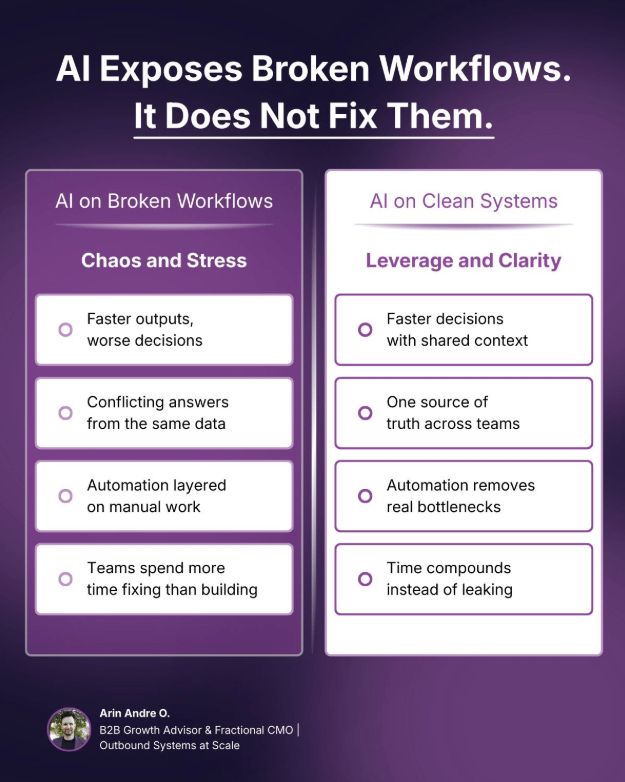
➡️ Arin Andre O. on LinkedIn:
AI is not replacing teams.
It is replacing inefficiency.
Most companies are layering AI on top of broken workflows.
That is not leverage.
Real leverage comes from:
clear decision-making rights
defined ownership (no shared accountability)
systems that work without heroics
AI amplifies logic.
These are the highlights for the last week.
Until next!
Vahe Arabian and the editorial team at SODP
.JOB BOARD.