- SODP Weekly Bulletin
- Posts
- The Weekly Bulletin | March 31, 2026
The Weekly Bulletin | March 31, 2026
Catch up on your members' content, check out the community buzz, and browse through job opportunities

Vahe Arabian
March 31, 2026

Hi SODP community,
Let's recap on what's been happening, the new content, industry updates, tips, and more.
.TIP OF THE WEEK.
Think Like a Creator: How Publishers Can Reclaim the Ad Budgets
Advertising budgets are not gone; they’ve simply shifted to creators who act like publishers.
For years, businesses relied on big ad networks and media agencies to distribute their budgets. But spending patterns are changing. Increasingly, we see brands allocating funds directly to individuals who can create content that resonates, drives attention, and fosters trust with their audiences.
This doesn’t mean advertising is shrinking; it’s just moving closer to the people who can capture attention with relevance and authenticity. The challenge for publishers and businesses is clear: how do you act like a content creator to access these dollars?
Marketers are under pressure to prove ROI. Instead of broad placements, they’re betting on creators who deliver measurable engagement in niche communities. Research shows that influencer marketing spending continues to rise, with global estimates in the tens of billions annually (Statista, 2025).
That money isn’t disappearing; it’s just flowing through different pipes.
What content creators are doing right
Creators earn this share of the budget because they:
Publish consistently: They show up regularly with content that’s fresh, timely, and aligned with audience interests.
Focus on niche authority: They don’t try to be everything to everyone; they build depth in one area.
Foster community: Engagement is two-way, not broadcast-only.
Show personality and trust: Their audience knows who is behind the content, which builds credibility.
How can publishers adapt:
If you want to attract these budgets, act more like a creator:
Prioritise storytelling and expertise: Showcase the human side of your brand alongside expertise in your subject matter.
Invest in consistent output: Treat your publishing cadence with the same discipline as a professional content creator.
Build identifiable voices: Authors, editors, and contributors should be visible, not hidden behind a logo.
Measure and prove value: Track engagement, conversions, and attention metrics, not just impressions.
Advertising money hasn’t disappeared. It has moved closer to creators who can demonstrate relevance, authenticity, and impact. For businesses and publishers, the opportunity is to stop thinking like an ad slot and start thinking like a trusted creator who can tell stories, build audiences, and drive results
.NEWS OF THE WEEK.
➡️Helping publishers thrive on Reddit. Today we’re expanding access to Reddit Pro’s tools for publishers. Any publisher who wants to grow their reach on Reddit can sign up, verify their domain, and get access to the Links tab in Reddit Pro for free as part of our public beta test. With over 55 billion views of publisher and news-related conversations in 2025. Reddit is already where people come to find stories and have conversations about them.¹ We first piloted these tools with select publishers six months ago to help media outlets share their content and spark conversations on Reddit. In return, these publishers are making it easier for redditors to discover, read, and discuss the latest headlines.
➡️ llms.txt Was Step One. Here’s the Architecture That Comes Next. The conversation around llms.txt is real and worth continuing. I covered it in a previous article, and the core instinct behind the proposal is correct: AI systems need clean, structured, authoritative access to your brand’s information, and your current website architecture was not built with that in mind. Where I want to push further is on the architecture itself. llms.txt is, at its core, a table of contents pointing to Markdown files. That is a starting point, not a destination, and the evidence suggests the destination needs to be considerably more sophisticated. Before we get into architecture, I want to be clear about something: I am not arguing that every brand should sprint to build everything described in this article by next quarter. The standards landscape is still forming.
➡️How Publishers are Balancing AI Fear with Opportunity. The publishing ecosystem is a perfect microcosm for the often-conflicting feelings of fear and opportunity that come with AI adoption. But publishers are also no strangers to tech and economic disruption, and this experience is playing out in Australia as they take to AI with innovation, while safeguarding on quality and ethics. Take News Corp, for example, which has inked global deals with the likes of Meta and OpenAI to use content from the Wall Street Journal, The Times, and The Australian to train its models. Closer to home in Australia, the attitude there is more mixed, with executive chair Michael Miller last year saying publishers need to create a "united front" against social and tech firms, yet the company itself has been building out its own NewsGPT tool.
➡️ Wikipedia Bans Most AI-Generated Content, Advertisers May Benefit. Wikipedia has remained one of the main sources of information in AI and traditional search queries, but updates to its editing policy for the English version surfaced on Friday that make it clear all site moderators cannot use large language models (LLMs) to generate content for the site. Although this may create immediate hurdles for advertisers and marketers relying on automated tools to increase online traffic to websites and foot traffic to stores, it could have a long-term positive impact on marketers prioritizing quality. SEO marketers focused on Generative Engine Optimization (GEO) could find this ban beneficial, because it prevents what Wikipedia calls "model collapse," where AI engines train on AI-generated Wikipedia content, ensuring that the "knowledge graphs" powering Google’s AI Overviews and other chatbots remain grounded in human-verified facts.
➡️ NTM’s subscription strategy to reach young readers increases digital revenue 34%. The transition from print to digital has fundamentally changed how audiences discover and consume news. For younger generations, local journalism is no longer a default part of everyday life but something they must actively choose — within a media landscape dominated by global platforms such as Meta, Spotify, and Netflix. Like many news companies, Swedish NTM’s local newsrooms have been facing a clear challenge for many years. While we have a strong subscriber base, it is heavily skewed toward older generations. Younger audiences have often had low awareness of local news brands, a limited willingness to pay, and consumption habits shaped by social media and mobile platforms.
➡️ Is Linear Programmatic Finally Here? The short answer: not yet, and taxonomies matter. If the broadcast industry wants to move forward with credibility and confidence, clarity will serve us better than overstatement. Over the past year, a growing number of technology partners and industry initiatives have begun promoting what they call “programmatic linear TV.” Platforms such as ONX, ITN Programmatic Hub, the ITN-Magnite partnership, and the Linear Trading Platform (LTP) being developed by the TVB are all aimed at modernizing how linear television is bought and sold. [Editor’s note: An earlier version of this column mistakenly referred to the ITN-Magnite product as PVX (ProVantageX).] Let me start by saying this clearly: These are valuable initiatives.
.SODP POSTS.
Meta and Google just lost a landmark social media addiction case. A tech law expert explains the fallout
Social media platforms Instagram and YouTube have a design defect which means they are addictive, a jury in the United States has ruled.
The Los Angeles jury took nearly nine days to reach its verdict in the landmark case brought by a woman known as KGM against social media platforms. It awarded US$3 million in damages, with Meta (owner of Instagram) being 70% responsible and Google (owner of YouTube) 30%. The jury later awarded a further US$3 million in punitive damages.
Both TikTok and Snap settled on confidential terms before the six-week trial commenced.
This is Meta’s second big loss in the US courts this week, with a New Mexico jury finding the company guilty on March 24 of concealing information about the risks of child sexual exploitation and the harmful effects of its platforms on children’s mental health.
KGM’s case is the first of its kind, but won’t be the last: it is one of more than 20 “bellwether” trials due to go to court soon. These are essentially test cases used to gauge juries’ reactions and set a legal precedent.
As such, the verdict is set to have far reaching ripple effects. It could be big tech’s big tobacco moment, with thousands more similar cases waiting in the wings.
.UPCOMING EVENT .
SODP Dinner in London
We're hosting an off-the-record dinner for senior product, engineering, and editorial leaders on Tuesday, June 9 at Cornus Restaurant, London (6:30 PM). The focus: how to build platforms that scale under pressure without sacrificing engineering velocity, governance, or editorial ambition. You'll get candid peer exchange on platform architecture, organisational resilience, and AI strategy. We will have Marcel Semmler (Global Chief Product Officer, Bauer Media Group) and Dmitry Shishkin (former CEO of Ringier Media International, advisor to BBC, Condé Nast, Thomson Reuters) as speakers for the day. There would be dinner, drinks, strategic insights that won't be shared publicly, and access to our private post-dinner network. Seats are limited.
➡️ Omnicom Media Group (London) is looking for an Audience Manager to develop the audiences based on all the platforms and data available and interrogating data sources to derive insight to support the creation of the audiences, as well as curating insights from the local markets. (London).
➡️ News Corp Australia is seeking a Partnerships Director to join their team, who will act as a senior leader in the team, responsible for driving the success of a market leading digital partnership within the retail sector. (Australia)
➡️ Newsweek (United States) is looking for a Business Development Manager who will own the full demand-side partnership lifecycle on their Exchange — from prospecting and integrating new DSPs to ensuring connected buyers are actively and consistently spending. (U.S)
➡️ Jes Scholz on LinkedIn:
Today I read a $40K SEO audit from a client’s former agency. And was taken aback.
Over fifty pages. Full of GSC & SEMRush screenshots. Paragraphs of technical commentary. But...
There was not a single mention of their market position. Not one reference to their brand approach.
It was nothing more than very expensive diagnostics.
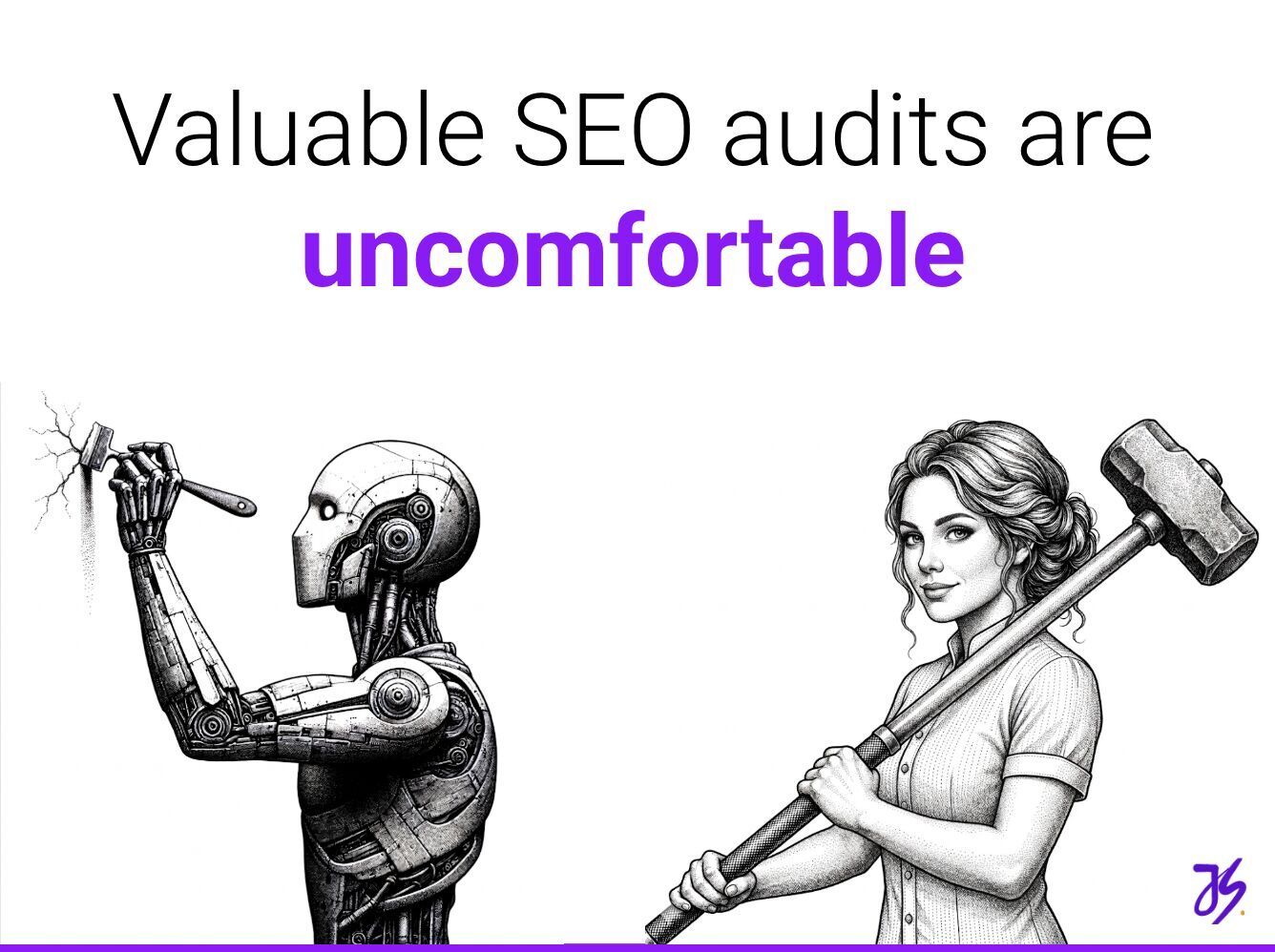
Any marketing action that can be systematised, belongs to AI. It is more efficient at finding tactical cracks. Consultants advise which walls to tear down.
Human audits should highlight opportunities that require roadmap rewrites, not technical tidy-ups.
Valuable audits are uncomfortable. The point out:
🟣 Out of date architecture working against your current positioning
🟣 Product content that fails to demonstrate differentiation
🟣 Dull copy so interchangeable it could sit on a competitor site with no edits
🟣 Distinctive brand assets diluted or ignored entirely
🟣 Reporting on true share of voice in the market category, not a select set of convenient keywords
These are the highlights for the last week.
Until next!
Vahe Arabian and the editorial team at SODP
.JOB BOARD.