- SODP Weekly Bulletin
- Posts
- The Weekly Bulletin | March 24, 2026
The Weekly Bulletin | March 24, 2026
Catch up on your members' content, check out the community buzz, and browse through job opportunities

Vahe Arabian
March 24, 2026

Hi SODP community,
Let's recap on what's been happening, the new content, industry updates, tips, and more.
.SODP POSTS.
From Intuition to Data: Optimizing Content for Google Discover’s Evolving Pipeline
For a long time, most of us have approached content in a similar way.
We build clusters, look at Google Trends, rely on subject matter expertise, and try to connect those pieces into something cohesive. But in practice, it’s often been disjointed. Even when it works, it’s difficult to explain why — and even harder to repeat.
Why this matters now
Earlier this year, Google rolled out a Discover-focused update (February 2026), largely in response to increasing spam and system exploitation. That alone is telling.
It confirms two things:
Discover is now critical enough to warrant dedicated updates
And more importantly, people have already been learning how to work its feedback loops
Which raises a question for publishers: If others are actively learning how these systems behave — are we still relying on intuition?
What changed my thinking
Over the past year, a number of researchers have helped surface a clearer picture of how Discover works. Work from people like Metehan (through SDK analysis) and Damien Andell (through detailed pipeline and recommendation system research), alongside broader publisher testing, has shown that Discover is not a single algorithm.
It is a structured system:
A multi-stage pipeline
Multiple recommendation pathways
Scoring models such as predicted CTR
And feedback loops that reinforce or suppress visibility
This wasn’t something I discovered — but it was enough to act on.
Why I built the tool
The Discover Content Check tool came from that shift. Not to replicate the research, but to operationalise it.
Instead of:
Publishing and hoping
Or relying purely on editorial instinct
The goal was to create something closer to how Discover itself behaves:
A feedback loop for publishers.
Audit → understand → improve → re-test.
Because if the system is learning from performance. Then our workflows need to do the same.
What became clear through building it
A few patterns emerged consistently.
Technical optimisation is necessary, but not decisive.
It determines whether content can enter the system — not whether it will scale.
Predicted CTR plays a gating role.
It helps explain why content can be fully indexed and technically correct, yet never reach meaningful distribution.
Performance compounds through feedback.
Clicks, engagement, and dismissals feed back into visibility, shaping not just one article, but future distribution potential.
Distribution is no longer purely editorial.
It is increasingly influenced by behavioural signals, social engagement, and AI-driven personalisation layers.
The broader shift
This is where the gap is becoming more visible.
Most publishers are still operating through:
Topic selection
Content clustering
Editorial judgement
While Discover is operating through:
Prediction
Feedback loops
Continuous optimisation
The intention behind building this tool was to start closing that gap.
Not by “gaming” the system — but by understanding it well enough to work within it deliberately.
What I’ll be sharing at Phuket Summit
At Phuket Summit, I’ll be focusing on how this translates into practice:
How the Discover pipeline influences distribution
Where content typically fails
How to think about predicted CTR before publishing
And how to introduce feedback loops into your workflow
Alongside a live walkthrough of how we’re applying this through the tool.
Closing thought
This isn’t about replacing editorial thinking. But it is about recognising that the systems distributing our content have changed. And if those systems are learning continuously. Then the way we create and optimise content needs to evolve with them.
11 Best Content Analytics Software for Publishers in 2025
Do you have an eye on top performing content your audience craves and the content analytics tools to help you work smarter, not harder? WordPress claims that its users publish about 70 million new posts every month. With almost millions of blogs posted every day, publishers need more than just quality content to stand out. Content analytics help publishers gain valuable insights into how their content is performing and what type of content resonates most with their audience.
This article will define content analytics tools, discuss their importance for publishers, and review the best content analytics software solutions available in 2025.
What Is Content Analytics Software? Content analytics software is a toolset that helps teams assess how readers interact with their published material.
According to Grand View Research, the global content analytics market size was valued at USD 9.31 billion in 2024 and is predicted to grow at an annual rate of 18.9% from 2025 to 2030.
Beyond user behavior, content analytics helps publishers understand reader preferences, recognize trends, and refine their content marketing efforts accordingly.
How Does Content Analytics Software Work? A content analytics platform enables publishers to accurately measure the impact of their content and make informed, data-driven decisions. Apart from views or feedback, it helps publishers uncover patterns in reader behavior and discover best performing formats.
.NEWS OF THE WEEK.
➡️ When the Training Data Cutoff Becomes a Ranking Factor. Every AI system serving answers today operates with two fundamentally different memory architectures, and the boundary between them runs along a single invisible line: the training data cutoff. Content published before that line is baked into the model’s weights, always accessible, confident and unreferenced. Content published after that line only surfaces when the model retrieves it in real time, which introduces a different retrieval path, a different confidence profile, and, critically, different presentation behavior in synthesized answers. If you’re optimizing for brand visibility in AI-generated search, this distinction is not a footnote. It is the organizing principle.
➡️Limited strategic prioritisation, misaligned value propositions are responsible for registration failure. For years, the digital news industry has optimised around subscriptions. But as subscription growth plateaus in many markets, publishers like The Australian and The Guardian are revisiting an earlier stage of the reader journey: registration. Registration sits between anonymous traffic and paid conversion in the audience funnel. It allows publishers to identify readers, build first-party data, and increase engagement before introducing subscription offers. In practice, however, this layer of the funnel is often under-developed. Many publishers still have overwhelmingly anonymous audiences, limiting their ability to personalise experiences, build habit, or target subscription messaging effectively.
➡️ Meta Reduces Reliance on Third-Party Vendors for Content Moderation in Favour of AI; Walmart Secures Patents for Algorithmic Pricing. Meta Platforms has announced plans to expand the use of advanced AI in content moderation, signalling a further shift away from third-party vendors. The strategy represents a wider shift in Meta’s approach to moderation, reducing reliance on external moderation partners and focusing on its internal AI systems. The company said the AI systems will be rolled out more widely once they consistently outperform existing methods, taking on tasks such as detecting and removing content related to terrorism, fraud, and scams. Human reviewers will continue to handle complex and high-risk decisions, including account disablement appeals and law enforcement referrals.
➡️ Google Expands Personal Intelligence in Search. Google has expanded “Personal Intelligence” in the U.S. across AI Mode in Search, the Gemini app, and Gemini in Chrome. The feature connects products like Gmail and Google Photos to generate more tailored answers and recommendations, and Google says it is now available in AI Mode for U.S. users and is starting to roll out to free-tier Gemini app and Gemini in Chrome users. Google also says the experience is limited to personal Google accounts, not Workspace business, enterprise, or education accounts. For site owners, that matters because it pushes search one step deeper into a personalized answer layer.
➡️ Is WordPress Too Complex For Most Sites? Joost de Valk, the co-founder of the Yoast SEO plugin, provoked a discussion and some controversy with a recent blog post that posited that the concept of needing a content management system (CMS) to publish a website is increasingly outdated. This insight came to him after migrating his site to a static Astro-based website with the help of AI. Joost wrote that the reality today is that many businesses and individuals need nothing more complicated than a static website and that a CMS is overkill for those simple needs. He affirmed that CMSs are vital for building complex websites, but he also makes the case that the complexity problem that a CMS solves is not representative of the needs of most websites
➡️Companies Aren’t Ripping Out Business Software for AI. Here’s What They’re Doing Instead. Despite the AI-driven software stock meltdown, America’s largest corporations aren’t ditching their core business software just yet. Instead, they’re using the moment to squeeze better deals from vendors and “vibe-code” smaller apps and software customizations. And their efforts could be providing a preview of what comes next, when AI agents drive more workflows on top of that software. Vishal Talwar, chief digital and information officer of FedEx, said the shipping giant is “not looking at this point for [software] to leave our enterprise.” Yet he sees the uncertainty over software’s future, and the advent of AI agents, as a chance to re-evaluate how it is priced.
.TIP OF THE WEEK.
How to plan for Google Discover content clusters
Most people use the Audit, Calendar, and Authority Builder as separate tools. The ones getting better results chain them together, and this is where the Discover Content Check tool comes in.
Here's the exact sequence:
Start with an Audit: Run it on your best-performing or most important article (New Audit → paste the URL)
Build the Calendar from that audit: Hit "Build Calendar" directly from the audit result — it pre-fills the calendar around that specific article, not generic topic suggestions
Run Discover Topic Gaps in the Authority Builder: Select the same article as the source → run "Discover Topic Gaps" → get the 5–8 supporting articles you need to build the full interest graph cluster
Cross-reference both outputs: Articles appearing in BOTH the calendar and the gap analysis = your highest-priority commissions They're trending AND they strengthen your authority cluster simultaneously
Check entity overlap before commissioning: Export the calendar to CSV → paste titles into the Authority Builder's URL field one by one → verify entity overlap with your existing content
The key insight most publishers miss:
Google Discover ranks publishers, not just articles.
The Calendar tells you when to publish. The Authority Builder tells you what cluster of content to build.
Used together, you're not optimising one article — you're engineering a topic cluster that signals deep authority to Google's interest graph, which compounds distribution over time.
Practical shortcut:
Export the calendar to CSV, then
Paste the titles into the Authority Builder's URL, and
Field one by one to check entity overlap with your existing content before commissioning.
➡️ GB News (London) is looking for a Brand Marketing Manager who will shape and scale their brand at a pivotal moment of growth, and lead the development and delivery of high-impact, multi-channel campaigns, bringing the GB News brand to life across on-air, digital, social and third-party platforms. (London).
➡️ MediaNews Group (U.S) is searching for a highly motivated and results-driven Advertising Sales Manager to lead digital advertising sales and revenue growth for the Southern California News Group. (U.S)
➡️News Corp Australia is looking for a Group Digital Lead to drive digital revenue growth within their Client Partnerships team, and elevate digital capability, embedding sophisticated digital thinking into client strategies, and unlocking growth opportunities across their diverse portfolio of digital assets. (Australia)
.UPCOMING EVENT .
SODP Dinner in London
We're hosting an off-the-record dinner for senior product, engineering, and editorial leaders on Tuesday, June 9 at Cornus Restaurant, London (6:30 PM). The focus: how to build platforms that scale under pressure without sacrificing engineering velocity, governance, or editorial ambition. You'll get candid peer exchange on platform architecture, organisational resilience, and AI strategy. We will have Marcel Semmler (Global Chief Product Officer, Bauer Media Group) and Dmitry Shishkin (former CEO of Ringier Media International, advisor to BBC, Condé Nast, Thomson Reuters) as speakers for the day. There would be dinner, drinks, strategic insights that won't be shared publicly, and access to our private post-dinner network. Seats are limited.
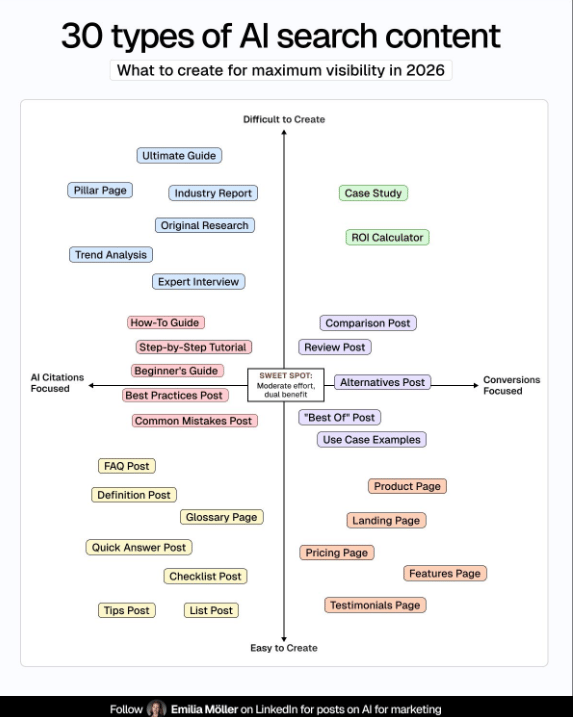
➡️ Emilia Möller on LinkedIn:
30 types of content get AI citations.
Most brands create zero of them.
Both old and new SEO demand a content strategy built across four quadrants.
Here's the full breakdown:
The first group is low effort, but has a high citation potential:
FAQ Post
Definition Post
Glossary Page
Quick Answer Post
Checklist Post
Tips Post
List Post
These build AI visibility fast without heavy resource investment.
The next group are easy and focused on conversions:
Product Page
Landing Page
Pricing Page
Features Page
Testimonials Page
These convert the traffic you're getting.
Once AI platforms cite you, these pages turn into customers.
The third group is a bit more complex, but gets citations:
How-To Guide
Step-by-Step Tutorial
Beginner's Guide
Best Practices Post
Common Mistakes Post
These are the highlights for the last week.
Until next!
Vahe Arabian and the editorial team at SODP
.JOB BOARD.