- SODP Weekly Bulletin
- Posts
- The Weekly Bulletin | March 10, 2026
The Weekly Bulletin | March 10, 2026
Catch up on your members' content, check out the community buzz, and browse through job opportunities

Vahe Arabian
March 10, 2026
Hi SODP community,
Let's recap on what's been happening, the new content, industry updates, tips, and more.
.TIP OF THE WEEK.
Hyperlocal SEO: How Regional Publishers Win by Going Smaller, Not Broader
Hyperlocal content isn’t just community news; it’s becoming one of the most effective SEO strategies for regional publishers to build authority and grow sustainable traffic.
For regional publishers, competing with national outlets on broad topics is a losing battle. Search engines reward specificity, relevance, and proximity. Hyperlocal content covering issues, events, and stories tied to a particular region or suburb naturally aligns with local search intent. When paired with a solid local SEO framework, it positions publishers as the go-to source for community information.
Local SEO focuses on making content discoverable for geographically relevant searches.
For publishers, this can mean:
Optimising articles with suburb or city modifiers in headings, titles, and metadata.
Building strong internal linking structures between hyperlocal content pieces.
Using schema markup such as LocalBusiness, NewsArticle, or Event to provide clearer signals to search engines.
Tracking impressions and clicks from Google Search Console at the regional keyword level to guide content priorities.
These practices directly improve visibility in local SERPs, news results, and even Google Discover, where localised and timely content has a higher chance of surfacing.
Practical Opportunities for Publishers
Regional publishers can take advantage of hyperlocal SEO by:
Creating evergreen guides on “things to do” or “local area highlights” to capture consistent search demand.
Covering recurring events with optimised, updated pages that build search equity year after year.
Leveraging local data sources, council announcements, and community feedback to develop unique stories unavailable to larger publishers.
Monitoring keyword cannibalisation across neighbouring towns or suburbs and consolidating where necessary.
The opportunity is not just about traffic; it’s about engagement. Readers searching for local content are more likely to subscribe, share, and convert into loyal audiences.
Regional publishing has always been about serving communities. Local SEO and hyperlocal content now provide a scalable, data-driven pathway to make that service visible in search. Publishers who embrace this shift are more resilient against algorithm changes and better positioned to attract advertisers looking for engaged, location-specific audiences.
.NEWS OF THE WEEK.
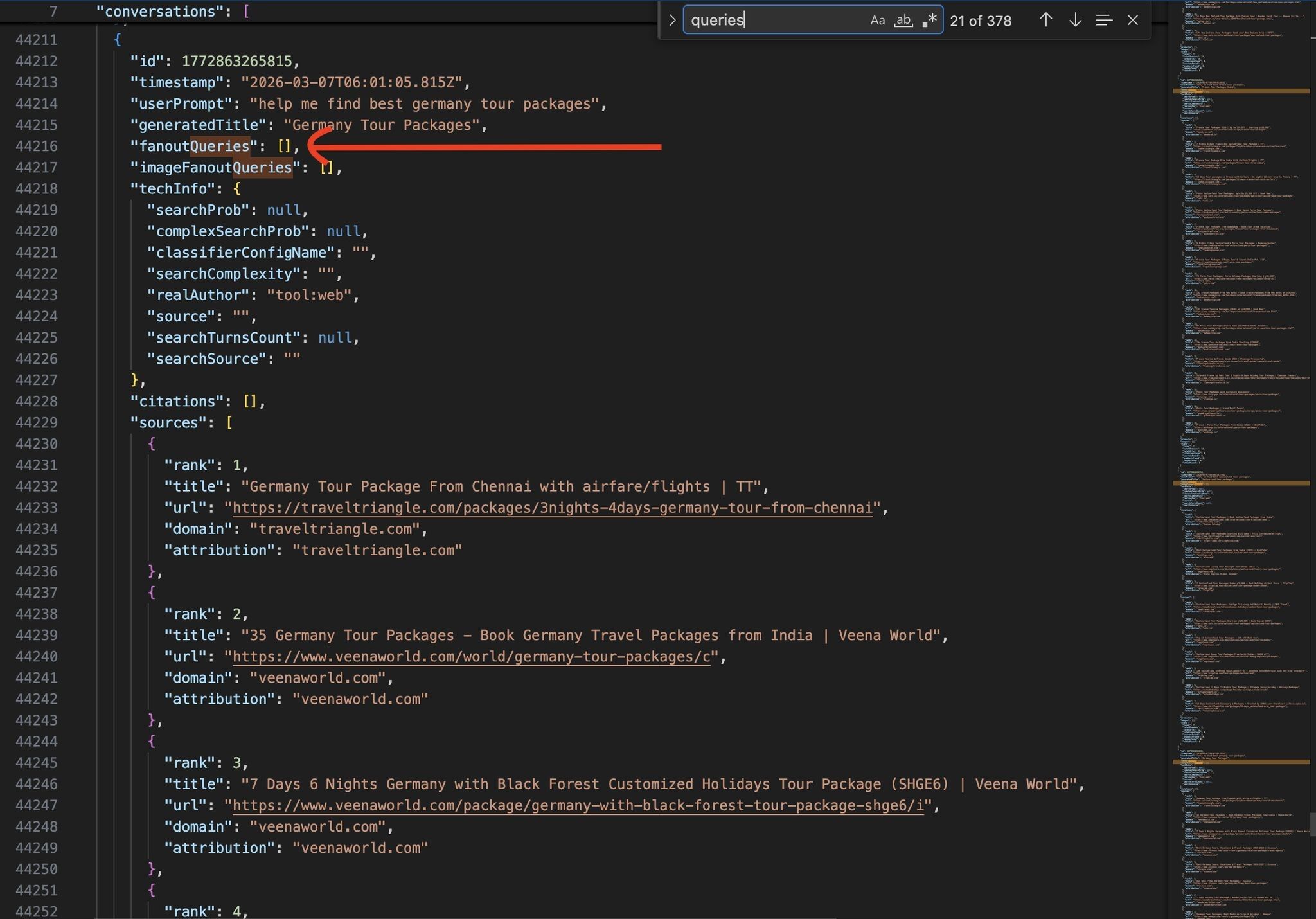
➡️ The Shortcut Behind Some AI Optimization Tools. On March 3, 2026, OpenAI pushed GPT-5.3 Instant to all ChatGPT users, free and paid, with no fanfare about what else might have changed beneath the surface. Within days, SEO and AI search practitioners began documenting something unexpected: the internal metadata that had allowed third-party tools to observe ChatGPT’s query fan-out behavior (the sub-queries the model generates behind the scenes before composing a response) was no longer visible. A German SEO publication, SEO Südwest, published a detailed account on March 7th, noting that researchers Chris Long and Jérôme Salomon had independently observed the same thing (and noted the correct work-around).
➡️An NFL Antitrust Debate May Determine Local Broadcasting’s Future. The long-term economics of local television could be fundamentally reshaped if broadcasters don’t engage forcefully in the discussion unfolding around sports rights and antitrust policy. The National Association of Broadcasters has fought many regulatory battles over the decades — spectrum policy, ownership limits, retransmission consent and NextGen TV among them. But a new policy debate emerging in Washington may eclipse them all. The growing scrutiny of the Sports Broadcasting Act of 1961 could become the most consequential fight for broadcast television in a generation.
➡️ What Immediate Media’s YouTube channel reveals about new content economics. Immediate’s magazines used to compete for newsstand space and Web site hits. Now they compete for watch time, ear time, and scroll time. This “liquid content” factory quietly shifted to video-first. I recently found myself watching a historian explain what ordinary Tudors really ate. Not King Henry VIII’s banquets but everyday 16th-century life. The shift from wood to coal changed English kitchens and even the taste itself, as less smoke required more seasoning. The episode was filmed at a period townhouse in Wales. It is part of HistoryExtra magazine’s Tudor Life series with historian Ruth Goodman.
➡️ WordPress Releases Updated AI Experiments Plugin. WordPress contributors have released AI Experiments 0.4.1, adding built-in image generation and AI-assisted review tools directly inside the block editor and admin interface. The update became available on March 5, 2026, through the official plugin and its GitHub release page. The new version enables authors to generate images from text prompts and receive Notes-based feedback about content. The AI Experiments plugin serves as the canonical plugin powering experimental AI-powered features in WordPress for content creators to use, giving them a preview of what might be available in the future.
➡️ Organic search is fundamentally disrupted. Here’s what to do about it. With Google referrals down and LLM use rising, discoverability now depends on metrics, structure and authority — not rankings alone. If your organic traffic is down but impressions are up, AI is likely citing your content without sending clicks. If both are down, you’re being ignored. Either way, the search behavior your marketing strategy was built on has changed, and waiting for traffic to rebound isn’t a strategy. This is the reality you’re facing in 2026. According to KEO Marketing: 73% of B2B websites saw significant traffic losses between 2024 and 2025, with an average 34% year-over-year decline.
➡️The AI knife shrinking advertising jobs. Global advertising groups are using AI as both a growth tool and a cost lever, with staff levels as a whole sliding, according to the latest financial results from holdcos. The headline competition is between data and technology platforms and the ability to demonstrate measurable business outcomes for clients. Creativity is still a key differentiator but returns, at least those acknowledged above the line (and many argue that this is almost given away to clients), are smaller. For example, Omnicom, now the world's biggest advertising player with its combined IPG takeover business, puts creative at 20% of its business.
.SODP POSTS.
What online master’s programs reveal about the convergence of digital publishing and journalism
Online master’s programs have become a quiet signal of where journalism and digital publishing are heading together. Over the past decade, universities have rebuilt graduate media education around the reality that content now lives across platforms, audiences interact directly with creators and editorial decisions are inseparable from technology and business considerations. In fact, in recent U.S. data, roughly one in four graduate students is enrolled exclusively in an online program (Research.com), underscoring how deeply digital education has penetrated higher learning across fields, including media and communication. This trend reflects broader growth in online enrollment, where more than half of all college students now take at least one online course and millions complete fully remote degrees each year (Research.com).
When you look closely at how these programs are structured, you can see the media industry’s priorities reflected back at you: adaptability, fluency with digital tools and an ability to move between storytelling and strategy. These programs now acknowledge that today’s media professionals may publish investigative reporting one day, manage analytics dashboards the next and collaborate with designers or developers the day after. Online delivery further reinforces this shift, emphasizing flexibility, self-direction and real-world relevance. In many ways, graduate education has become a mirror of the digital newsroom and publishing environment itself, offering insight into how boundaries between fields continue to blur in practice.
.SODP DINNER IN LONDON .
We're hosting an off-the-record dinner for senior product, engineering, and editorial leaders on Tuesday, June 9 at Cornus Restaurant, London (6:30 PM). The focus: how to build platforms that scale under pressure without sacrificing engineering velocity, governance, or editorial ambition. You'll get candid peer exchange on platform architecture, organisational resilience, and AI strategy. We will have Marcel Semmler (Global Chief Product Officer, Bauer Media Group) and Dmitry Shishkin (former CEO of Ringier Media International, advisor to BBC, Condé Nast, Thomson Reuters) as speakers for the day. There would be dinner, drinks, strategic insights that won't be shared publicly, and access to our private post-dinner network. Seats are limited.
➡️ Semafor (U.S) is looking for Director of Events and Live Journalism who will work closely with the SVP and Head of U.S, and will use entrepreneurial, innovative, out-of-the-box thinking to bring to life their portfolio of newsworthy and impactful high-quality events. (U.S).
➡️ The Telegraph (U.K) is looking for a CRO Manager who will support conversion initiatives by thoroughly understanding their audiences, identifying quality segments, spotting opportunities to move faster and working across multiple teams to ensure cohesiveness and maintain agreed objectives . (U.K)
➡️News Corp Australia is seeking an Head of Product who will be responsible for managing the planning, development, and execution of the FNL brands digital product portfolio roadmap - covering the brands news.com.au, Kidspot, Escape and Body & Soul. (Australia)
➡️ Vijay Chauhan on LinkedIn:
𝗧𝗶𝗺𝗲 𝘁𝗼 𝘀𝗮𝘆 𝗴𝗼𝗼𝗱𝗯𝘆𝗲... 𝘁𝗼 𝗾𝘂𝗲𝗿𝘆 𝗳𝗮𝗻𝗼𝘂𝘁 𝗱𝗮𝘁𝗮 𝗶𝗻 𝗖𝗵𝗮𝘁𝗚𝗣𝗧.
Well, for web search at least.
A few people are starting to notice but this is bigger than it looks.
GPT-5.3 dropped recently. And with it, web search no longer shows queries in the data stream or conversation blob. been missing for 2 days now. I confirmed it in real-time testing with chatgpt extension.
The Sonic tool? No longer used or recorded in the data sent across the wire.
Until now, when you asked ChatGPT something, it did this:
It broke your question into multiple web searches
Ran them in parallel
Synthesized everything into one answer
This is called query fan out.
Example:
"𝗪𝗵𝗮𝘁'𝘀 𝘁𝗵𝗲 𝗯𝗲𝘀𝘁 𝗽𝗿𝗼𝗷𝗲𝗰𝘁 𝗺𝗮𝗻𝗮𝗴𝗲𝗺𝗲𝗻𝘁 𝘁𝗼𝗼𝗹 𝗳𝗼𝗿 𝗿𝗲𝗺𝗼𝘁𝗲 𝘁𝗲𝗮𝗺𝘀?"
ChatGPT would run:
best project management tool remote teams 2025
project management software remote work comparison
top tools for distributed teams reviews
These are the highlights for the last week.
Until next!
Vahe Arabian and the editorial team at SODP
.JOB BOARD.